Loving Life Anyway

While I was channel-surfing the other day, I heard a guy repeat one of my pet bits of wisdom. “We like people because,” he said; “We love people anyway.”

That relates to life in general, too. We like it because; we love it anyway. Or at least we can hold a space for loving it anyway, even when things happen that we don’t like at all.

Start by identifying the things that make life feel worthwhile and satisfying, the things that give life its richness and let you feel alive.

That doesn’t mean that you should strive to live in an ocean of ease and contentment. Ease and contentment are pleasant islands in an ocean of everything else. It means savor the islands.

Feel-good emotions, like affection, contentment, curiosity, zest, and so on, are only a part of the picture. They light up our paths. They empower us.

But we need the seasoning that sadness and sorrow bring, too. We need to experience setbacks as well as success in order to be well-rounded, thriving beings. We need emptiness and loneliness as well as closeness.

The disappointments and setbacks are way-showers. They help us clarify what we want by showing us what we don’t want. They let us correct our course, refine our goals, or see new ones.

The trick is to let the negative emotions be the seasoning, not the main course. Notice the good times and the good feelings as they happen. Cultivate them and they’ll nourish you.

We need other things, too, in addition to the positive emotions. We need relationships that feel open and authentic, where appreciation, respect, and honesty flow back and forth.

We need to savor the things that make our lives feel meaningful, the moments of connection to something outside ourselves, something larger.

We need to feel interested and involved in something. It might be in our work, in our play, in our family or community, in our studies, in a hobby. We need stretches where we lose all track of time because we’re lost in the flow of it.

We need to feel that we’re accomplishing things—that our efforts bring positive results.

All these things work together to give us a sense of well-being, to let us know that life is good.

We each put the pieces together in different proportions. Somebody may get far more satisfaction from her relationships than from her accomplishments. Her neighbor feels most alive when he’s deeply engaged in his work.

These are the ingredients, the components; assemble them as you choose. Together, they give us the deep inner knowing that life is good, that our lives are good, regardless of the dips along the way.

None of us likes pain, or loss, or fear, or feeling insecure or discounted or betrayed. All kinds of things can, and do, happen in life that we would wish away if we could.

We don’t like life when we’re traveling down its dark and painful passages. While we’re in the grips of a fearful experience, it doesn’t matter that life is offering us the gifts of greater knowledge and discernment. It still hurts.

And that’s okay. The gifts will be revealed to us a bit farther down the road.

But build enough of the positive elements into your life—the empowering emotions, the engagement, the relationships, accomplishments and meaning—and even when there’s no because about life to like, you’ll still know, deep inside, that you love it anyway.

I had a coworker once who had a challenging, high-level job. When things would go wrong, she’d stomp down the hall, her head down, her fists clenched at her side, and steam coming from her ears as she spit out, “I love my job! I love my job! I love my job!” It’s like that sometimes, this state of mind. It plays with you.

Loving life anyway is what you do when your puppy poops on the carpet for the third time today. It’s what you do when your partner comes home and tells you that she’s wrecked your car. It’s what you do when your boss fires you, or when you learn that you have a serious disease. You love it anyway.

And you get there, to the land of Loving It Anyway, by building your gratitude for the things life offers when it’s good:

by savoring the moments of joy and serenity and love,

by throwing yourself into things that interest you,

by taking satisfaction in your achievements,

by valuing the people in your life,

by connecting with Something Higher, whatever you understand that to be.

Celebrate all the gifts life gives you to like, and appreciate, and enjoy. Notice them. And sooner or later, come what may, you’ll find yourself in the beautiful land of Loving Life Anyway.

Wishing you a season full of delightful moments, and a deep love for it All.

Warmly,
Susan

Image by uluer servet yüce from Pixabay
Thanksgiving Reverie

My first memories of Thanksgiving are like a Norman Rockwell painting come alive again in my mind.

For many years, Thanksgiving was a time when all my aunts, uncles, and cousins gathered together around a long table in Aunt Barb’s finished basement to feast on the traditional meal of turkey with every side dish you could dream of.

While the aunts worked at filling platters and bowls with steaming vegetables, mashed potatoes, gravy, relishes, salads, yams and stuffing, the uncles gathered in the living room upstairs telling their stories around the blazing fireplace.

We kids played tag and plunked on the upright piano in the big basement’s corner as we waited, and sometimes I’d sneak upstairs for a piece of chocolate from the fancy box of assorted variations that sat on the coffee table there. The men were sipping glasses of concord grape wine, and once my dad let me have a small sip of his to taste. 

I remember Cousin David, a tiny toddler, sitting at the table in his high chair gumming the turkey’s huge drumstick in glee. One cousin found the wishbone, and we all stopped eating to watch as she closed her eyes and made a wish, and then, with another cousin, pulled it apart, the larger half of it ending up in her hands, signaling that her wish would come true. Everybody laughed and clapped. Then they resumed passing endless bowls of food, the continuous murmur of their talk and laughter filling the room.

The memory glows golden in my mind.

But I have darker Thanksgiving memories, too.

One year, I had just moved to a new state with my 6-year-old son and knew no one. I had exhausted my meager savings and my cupboards were all but bare. I would have no more money until the following week when the first paycheck from my new job would arrive.

I sold a cherished piece of jewelry for $10 to buy a Thanksgiving meal of two chicken drumsticks, small cans of sweet potatoes and green beans, and a single piece of pumpkin pie to share with my son. I got a tub of whipped topping, too, for the pie, just to make the meal’s end special. 

Then there was the time when my neighbor, Mildred, after spending hours preparing the traditional feast for her husband and two teenage sons, watched them hurriedly shovel down the food without a word, eager to return to the football game on TV. As they rushed back to the living room, not one of them thanked her for the lovely meal.

So she cleared the remaining food from the table and stowed it away. Then she gathered up the four corners of her special table cloth along with her best tableware and china and dumped the whole bundle in the garbage can, determined never to cook Thanksgiving dinner ever again.

Remembering those stories always triggers a wave of compassion in my heart for those who find themselves excluded from the holiday’s celebrations. In addition to my prayers of gratitude I always ask for comfort and encouragement for them . . .

For the cold and lonely ones, those without family contact or a genuine friend, isolated from the warmth of community, some without a home,

and for the goodhearted ones who seek to provide them with meals and shelter, if only for this one day, out of gratitude for their own blessings;

For those who know no God to thank;
For those whose hearts feel only bitterness and despair;

For those serving the nation in foreign lands;
For those who suffer from injury or ill health; 
For those who who are dying, 
For the imprisoned;
For those in despair; 
For those who forego family celebrations to serve at their jobs.

I ask for special blessings, too, for all the families who still gather on this day to feast and give thanks, and for all whose hearts truly feel grateful, whatever their circumstances, for the manifold blessings in their lives.

And today, I give thanks for you, reading these words, from the bottom of my heart.

May you be filled with gladness, and love, and thanksgiving, now, and in all the days ahead.

Warmly,
Susan

Image by Print On Demand from Pixabay

Portents of Things to Come

It’s very November outside my window I see.

It started, a mere two weeks ago, with the gold crowns of trees billowing against a blue sky, their leaves tumbling in the wind, dancing to the ground, layering it in a blanket of gold.

Now they’ve rusted, their gold fading to brown, the branches above them bare, except for the oaks. The oaks are the last ones. They hold on.

This week a few flakes of snow fell as a preview of days to come. The seasons, I’ve noticed, send their emissaries in advance of their official dates of arrival.

I appreciate the kindness of that early warning. It saves us from the shock of going to sleep one green summer night, then waking the next day to see the world aflame with leaping oranges, scarlets, and gold. Or of trading autumn’s splendor overnight for trees that stand naked in two feet of snow.

It’s the same thing with the emergence of Christmas music and decor that’s steadily creeping along the streets and into the stores. They’re signs: The holidays are coming. Prepare.

No other time of year holds such intense drama, such contrasts of emotion as this. Such expectations! So many memories, and hopes and demands! We greet it with joyful anticipation, with dread, or with a feigned and determined indifference.

And then, beyond the lights and sounds, there’s the mystery of it, the tangle of stories and traditions that weave all through it, a kind of mass-seeking for its meaning, for the transcendence the stories imply, for the experience of somehow touching the divine.

We greet it, joyfully or with disdain. But we can’t ignore it; we can’t pretend that it isn’t here.

Personally, I’m going with a strategy of complete non-resistance. The year’s going to sing its grand finale, no matter what. I’ll joyously sing along with all the parts that call me and let others join in whatever parts may call to their hearts.

I tend to have a preference for the parts that sing of peace and love, and of silliness and fun. I’m all in for wishing the world joy, in any and all of its flavors.

The official start of the holiday season here in the United States begins with Thanksgiving Day on the last Thursday of November. For others, the start has different markers or quietly slides in unannounced. But it’s coming. It’s inevitable. Its energy envelopes us all.

I suggest that a good thing to take with us as we enter the days ahead is pockets full of extra kindness. It’s welcomed everywhere and often much in need. The contrasts of the season can, as you may have noticed, generate some stress. So save a big handful of kindness for yourself, too. Take time now and then to give yourself a hug and let yourself take comfort and peace in its warmth.

Last week’s snowflakes told the story. It’s coming. You can almost hear its bells chiming in the morning air.

It’s a gift, you know. Welcome it with an open heart and open arms.

You deserve it.

Warmly,
Susan

Image by Almeida from Pixabay

Need a Purpose?

Every now and then someone will mention the idea that we all have a purpose. And then they’ll unfailingly add, “I haven’t figured out what mine is yet.”

I had no idea what mine was either, although the notion that we each have a purpose was much more delightful than thinking we had none. That would be ridiculous.

I never gave the idea much thought, actually. I just figured life was unrolling the road as I traveled it and whether to take this branch or that I was free to choose.

To me, “purpose” always seemed like it should start with a capital P. It was like your destiny or something. And you’d discover it as you went along, although you might have to go a long way.

It seemed like it had to be grand and dramatic, even if in a relatively small way, like when those brave souls stop lanes of urban traffic to rescue a kitten stranded on the median.

Then the other day, for no particular reason, some voice in my head announced, “The purpose of your life is to be your Best Self, facing life’s struggles and opportunities with your values intact and your mind set on your ultimate goal.”

Well! That was pretty intriguing! It was the kind of thing you want to mull over a bit. It had some layers to it and a ring of truth somehow. It felt comforting, and fortifying.

I considered it a gift to those of us who sometimes ponder the purpose question.

Tuck it in your pocket if it appeals to you. Maybe someplace near your heart. Let it make you smile and feel confident and strong.

So, I thought to myself, purpose isn’t playing a spectacular role of some kind somewhere along your journey. It’s your day-to-day stretching into your Best Self, whatever you decide your Best Self is, all the while dealing with the ten thousand challenges and opportunities life throws at us all, and still remembering who you are, remembering to keep focused on your ultimate goal.

When you think about what it takes to fulfill that purpose, you realize it’s something easier said than done. It’s one of those things that takes some intention, discipline, and maybe a lifetime to master. But, oh! Think of the rewards!

Maybe “purpose” deserves to be written with a capital P after all.

Be you. Shine on.

Warmly,
Susan

Image by Andrzej from Pixabay

Focused Intention – Remembering Your Best Self

Whether you’re trying to improve a relationship, get to the gym more often, finish that report, or clean out the garage, one of the keys to achieving your goals is remembering your best self—the you that you aspire to be.

The things we’re aiming to achieve, after all, are a reflection of the values we hold and the traits we want to express. Maintain a focused intention on those things and watch the barriers to achieving them melt away.

Here’s a simple two-step process you can use to move more easily toward any goal.

Identifying Who You Want to Be

First, think about what you’re hoping to get from achieving your goal. Ask yourself the classic “WIIFM” question: What’s in it for me?

Even when the result you’re aiming for is represented by something tangible, like that finished report or that clean, organized garage, what you really want is the feeling that you lived out a value that you hold in high regard. You want the experience of holding the mindset or attitude that the process of achieving your goal asks of you.

Suppose, for example, that you want to improve your relationship with your partner who has been irritating you lately. What mindset or attitude could you adopt that might smooth things out? Who do you really want to be when you relate to her? Someone who is more patient, maybe? More caring? More empathic? More cheerful?

Imagine setting an intention to express those traits. Imagine how it would feel being that person in your relationship. Imagine how your partner would respond to a person like that.

Or suppose you have to work on an assignment that you’ve been putting off. Who would you have to be to dive into it? What traits could you express? More curiosity? Keener interest? A heightened sense of responsibility? More inventiveness?

No matter what you’re aiming to achieve, your goal is asking you to focus on being who you need to be in order to achieve it.

When you identify the traits you want to use and develop a focused intention to live them in your daily life, they will carry you toward your goal. It’s just a matter of remembering who you want to be—and step two, below, will show you how to remember.

Focused Intention

The second step in remembering who you want to be is creating a focused intention using a simple practice called the PARK technique. It firmly anchors your intention to live out the traits you want to express, and doing it takes only a minute or two.

Begin by choosing two or three traits you think will work best for accomplishing your goal. Then say to yourself, preferably out loud, “My intention is to be ___________ and _________ .”

Next, take a couple minutes to close your eyes and remember a time when you felt each of them and let yourself experience that feeling as fully as you can.

Feel a little smile on your face and, as you feel your first intended feeling, say its name while you tap the heart region of your chest three times—“Capable. Capable. Capable.” Then do it with the next feeling.

Great! You have created your focused intention.

 Next, you activate and strengthen it daily.

First, as soon as you wake in the morning, before you get out of bed, remember your intention, repeating the traits to yourself.

Second, as you go through your day, do the PARK exercise below to reinforce and nurture it. (A great way to remember it is to do it on the hour, or to do it before each meal.) Here’s how:

PPause in whatever you are doing, momentarily setting it aside.

ABecome Aware: Allow yourself to become fully aware of the present moment. Do a quick body-scan, and let go of any accumulated tension.Allow the muscles of your face, neck,shoulder and back to soften and relax.

Then notice the data your senses are bringing you: What are you seeing? Hearing? Smelling? Tasting? What is your skin feeling?

Next, do a quick review of all you have accomplished in the past hour and acknowledge yourself for it.

You can do all of this very effectively in a matter of a 10-15 seconds. If you can take a full 30 seconds or even a minute or two with it, luxuriating in the richness of the moment, you’ll find it especially refreshing.

RRemember: Briefly touch your heart center as you mentally repeat the traits you want to embody – “Efficient; Focused; At Ease.” – allowing the feeling of your intentions to be in your awareness for a moment. Know that the feelings are alive within you and gently guiding you. (If you’re in a public situation and uncomfortable touching your heart center, simply turn your attention to your heart.)

KKeep on Task: Return your attention to the task at hand or with the next one on your list.

That’s it! Choose two or three traits as vehicle for reaching your goal, install your intention to be immersed in them, do a morning reminder when you wake and practice PARK as you go through your day.

My coaching clients love this exercise, by the way. I hope you’ll give it a try and experience the well-being and success that it can bring you as you move toward your goals.

Wishing you delicious intentions!

Warmly,
Susan

Image by Natalia Lavrinenko from Pixabay

Sticks and Stones

An anti-bullying Public Service Announcement I’ve been hearing on the radio recently got me thinking about three rules my mother taught me for getting along with others in the world.

Rule 1

The first lesson came when I was about five and told my best friend, who was also my next-door neighbor, that she stunk.

She went home in tears, and her mother called my mother, and my mother said I had to go tell my friend I was sorry.

I protested, in tears. “But she does stink!” I told my mother, confused because I had already learned that it was wrong not to tell the truth.

My mother explained that the neighbors used a certain kind of oil on my friend’s skin to keep it soft, and that although I might find its smell unusual and even unpleasant, to them it had a soothing smell.

It was unkind of me to say that someone smells bad, my mother said. Then she told me The First Rule: “If you can’t say anything nice, don’t say anything at all.”

That rule has served me well. I’ve learned to keep my personal judgments to myself, or, when it seems necessary to speak out, to state my objections to someone’s behavior or remarks as tactfully as I can.

Rule 2

I learned my second lesson when a neighborhood bully called me a stupid brat.

My mom knew that other people aren’t always taught to keep unkind words to themselves. So she taught me The Second Rule: “Sticks and stones may break my bones, but names can never hurt me.”

Words were only words. They told you more about the person who spoke them than they did about you.

It was a popular rule in those days. It was like an invisible shield that bounced your assailant’s words right back at him, leaving you unscathed. You could hear kids on the playground at school yelling it at kids who were taunting them. It let them feel empowered. More kids ought to learn it today.

Instead, we seem to be teaching kids that others who haven’t learned The First Rule are criminals of sorts who need to be reported and punished, maybe banished from the playground altogether.

Sure, if we’re being threatened with physical violence, the situation requires some swift and effective intervention. But teaching kids that being called a name is devastating teaches them to feel vulnerable and to assign to the offender the power to wound with mere words.

Rule 3

A better alternative is to teach kids The Third Rule that I was lucky enough to learn from my mom: “Troublesome people are troubled people.”

Usually, my mother explained, they’re mean because someone has been mean to them. They’re confused and operating on bad information.

And while mean people may not be pleasant, if we got to know them, we might learn that all they need is some kindness and recognition. Their meanness is their way of trying to protect themselves; it’s a wall they put up to keep others away so they won’t be hurt again.

Sometimes, when you get beyond that wall, you can find that you’ve made a new friend.

That was a powerful lesson. It let me put the emphasis on the other person’s upset instead of blindly reacting to his insult. It helped me learn empathy and to grasp that I could choose my own emotional response. It put me in control.

In time, I learned how caring about the other person’s pain could be transformative for both of us. It let me move away from defensiveness into non-judgment and openness. It disarmed the other person by showing him that I saw him, not as a threatening monster, but as a fellow human being.

I like the balance of strength and sensitivity in those rules. It was good to think about them again and to be glad for the guidance they gave me. I hope they’re still alive and well today and that moms and dads everywhere are passing them on. It would make for a far saner world.

Wishing you a week of kindness, given and received.

Warmly,
Susan

Image by Nathan Osman from Pixabay

Your Super Power is Calling

Try this: At the end of this sentence, look up from your screen, do a quick survey of your environment, then come back.

It’s good to do a reality check every now and then, you know. See where you are. Notice what you’re feeling and what thoughts were going through your head that gave rise to those feelings. Then you can decide what you want to do and feel now.

Since you get to choose, let me invite you to include something elevating to pick from. Something that lets you feel relaxed and content. Satisfied. Refreshed. Maybe even grateful. Something that turns up the light inside you.

Maybe you’ll get a notion of something interesting, or needed, or fun, that you can do right now. Maybe you’ll think how good it would feel to give somebody a quick hello, to pour a little oil of kindness on somebody’s troubled waters, to go for a walk with the dog, to tackle a waiting project.

You can choose anything you want. You can even go back to where you were before you opened this letter if that’s what you want. Isn’t that cool? That we get to decide?

That’s what looking up from your screen will do for you. It puts you into reality. It opens the door to new possibilities. It lets you remember who you are, and that you are, and that you have the power to choose and to act on your choices.

It’s freeing to remember that. It’s one of the super powers we humans have. And it’s an awesome power. Our choices, after all, determine our destiny.

Maybe that’s why so many of us stayed glued to our screens. It feels safer than having to accept command of your own life, to consciously interact with reality.

But allowing yourself to get swallowed up in a sea of diversions doesn’t remove you from reality. Sooner or later, reality will catch up with you.

The life you’re living now is the result of your previous choices catching up with you. How your life will unfold in the future – ten minutes from now, ten months, ten years – will depend on the choices you make today.

Let yourself play with the possibilities. If you can’t see any, imagine them; make them up. Small or grand, it doesn’t matter. Then pick the shiniest one and take a step in its direction. Feel the wash of enthusiasm that one step creates. Go from there.

When you decide to put your attention on images and actions that let you feel at ease, alive, and motivated, you open the door to a richer, more interesting and gratifying life.

Look up from your screen now and then. Look around. See what invites your attention. What possibilities are calling you? What kind of tomorrow would you like to create? Just think! You get to choose, to decide!

Wishing you a week of beautiful, focused choices.

Warmly,
Susan

Image by StockSnap from Pixabay

Gratitude Rocks

“Remember,” speaker and author T. Harv Eker told his audience, “What you focus on expands. As I often say in our training, ‘Where attention goes, energy flows and results show.’”

That’s far more than a slick little slogan; it’s an explanation of how things work.

For instance, do you know anybody who’s always telling you about the things that go wrong for him?

I don’t mean the little things that go off-kilter in a given day, like when you can’t find your keys and you always put them in the same place, or in order to do what you want to do, you have to do something else first and then something else before that, or when everything you touch seems to slide right out of your hands. Not that kind of thing.

 I mean someone whose life, to hear him tell it, is a magnet for troubles, one grand string of crises, setbacks, and blind alleys after another. Do you know any of those?

I had a friend like that once. And there was no denying that bad luck seemed to cling to him like a cloud. The things that happened to him weren’t trivial or his recounting of them overblown. But over time I noticed that he never talked about anything else.

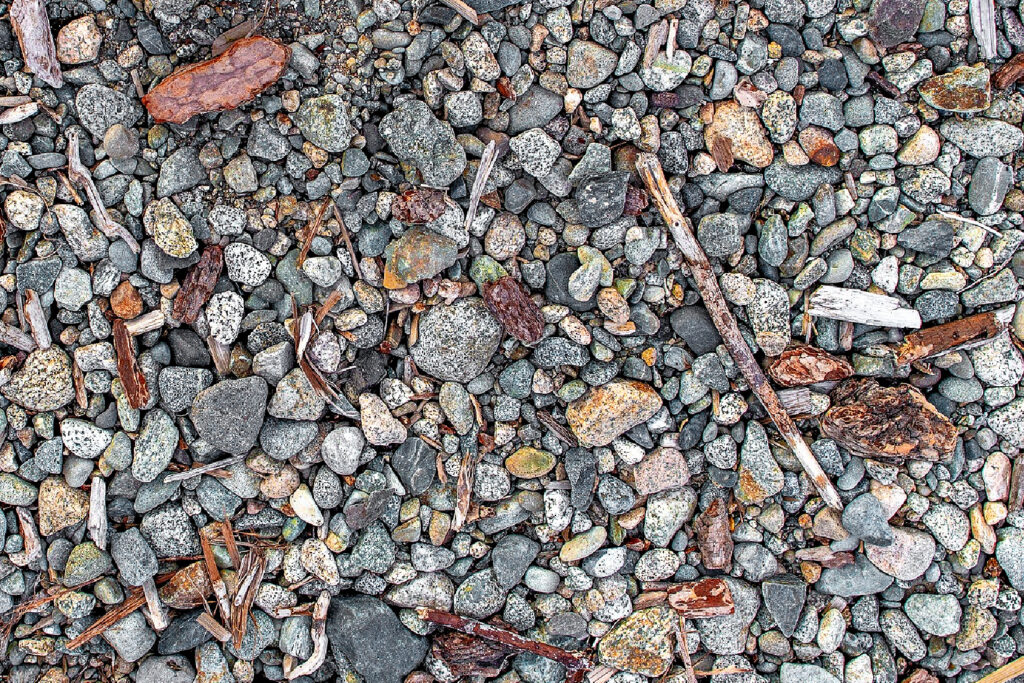
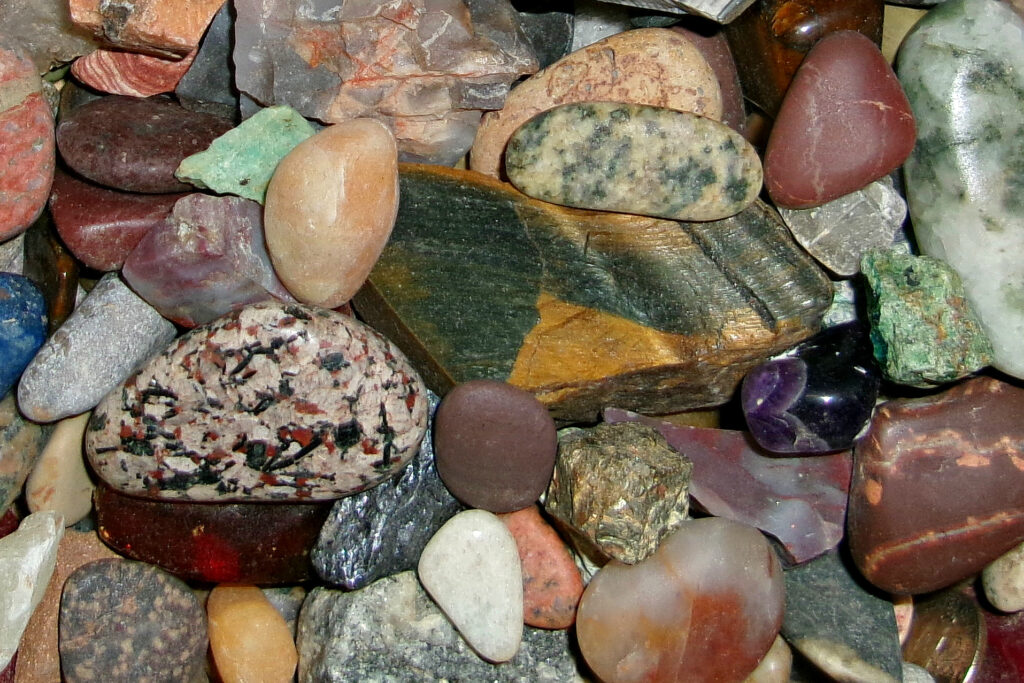
One day I asked him if he ever heard about gratitude rocks, and I told him the story about a man in Africa who brought a handful of pebbles from the creek to his village and told his neighbors that they were gratitude rocks and possessed of a great power.

 If you carried one in your pocket, he told them, and every time your fingers happened to touch the stone you thought of one thing for which you were grateful, unexpected blessings would befall you.

The people began to notice all kinds of good fortune coming their way. Soon, they began collecting and painting rocks and selling them to others as gratitude rocks, and in time the entire village prospered.

I took a polished pebble from my collection and gave it to him. “Feel it in your hand right now,” I told him. Feel its size and shape, its texture and temperature. Now think of one thing you’re grateful for. It can be anything, big or small.”

My friend’s face fell. He literally could not think of a single thing. I asked him what he had for lunch and what he liked best about it. “There’s your first thing to be grateful for!” I smiled when he told me the bread was fresh.

Weeks went by before I heard from him again. Then one night he called to tell me that he’d been having a surprising stretch of nothing-going-wrong. He almost felt superstitious about telling me, he said, as if he might be tempting fate. “Maybe that gratitude thing works after all,” he said, chuckling kind of shyly.

I laughed and told him now he could be grateful for gratitude, and he laughed with me. I won’t say that things turned around for him overnight. But his conversations began to be sprinkled with little mentions of things he was noticing and enjoying that he would have discounted or overlooked a month or two before.

The stories we tell ourselves about what’s going on in our lives—many of them “sticky stories” that we tell ourselves over and over—are energy patterns. Every time our attention gets hooked in them, we’re giving them our mental and emotional energy, and we tend to re-create the same kind of pattern over and over in our lives. What we focus on expands. That’s why it’s important to listen to the stories we tell ourselves about ourselves.

In your dominant stories, are you a victim or a victor? Do you always lose or do you always find a way to succeed? Are you irritated and angry with others, or do you strive to be patient and kind? See where you’re investing your energy, and notice the results. If you like them, keep on telling those kinds of stories.

If not, well, here: take this smooth little pebble. (Better yet, pick up a little pebble or safety pin or button of your own.) Feel it in your hand. Now think of something you’re grateful for and put it in your pocket. And put it in your pocket tomorrow, too, and the next day and the next. And every time your fingers touch it, think of something you’re grateful for. Even if it’s nothing more than not having lost your pebble yet.

You just might be surprised how powerful a little redirection of your energy can be. As Eker told folks, “results show.”

Wishing you a week where gratitude rocks – every single day.

Warmly,
Susan

The Yo Yo on the Escalator

My friend and I had been sitting in the airport’s baggage pick-up area for a while, waiting for our luggage to appear from the top of the revolving belt. There would be a bit of a delay the loudspeaker had announced, thanking us for our patience.

Several seats down, a mother lowered her wiggling toddler to her feet atop a blanket that she had placed on the polished floor. The baby, about 10-11 months old, wore a little pink sweatsuit, and had curly dark ringlets of hair framing her smiling face. She held tightly onto her mom’s fingers. Then she let go and fell onto her bottom, laughing in surprise.

She reached up to grab her mother’s outstretched fingers and pulled herself up to stand again. Once she was upright and balanced, she laughed, let go, stood for a quick moment, then tumbled down again, her face turning into a frown.

But the next second, she was reaching for mom’s fingers again to give it another go.

A thin, white-haired man with a cane who was sitting next to me learned forward in his chair to watch the baby stand and fall, stand and fall. He chuckled and said, “She’ll get it yet.”

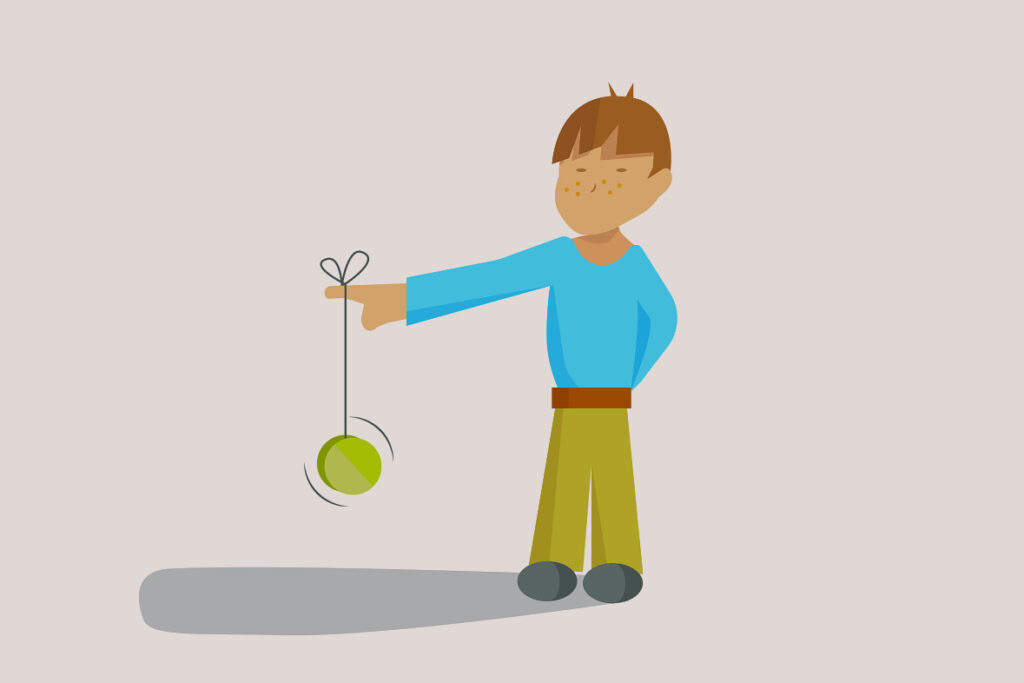
Just then a young teen walked past. He was playing with a yo yo that gave off sparkles of colored light as it moved down and up its string. He and his mom stepped onto an escalator that lead to the floor above, the boy not missing a beat with his yo yo as it steadily rose and fell.

“See?” the old man beside me said to nobody in particular, “Even when it looks like its falling, it’s still getting higher all the time.” He settled back in his seat, smiling at the toddler who was now cuddled in her mother’s lap.

Progress is like that. It takes practice to learn a new skill, to build new neural pathways in your brain before your new know-hows become automatic.

That young boy, so adept with his yo yo, probably had to untangle a few knots in its string and learn how far and how fast to move his hand and in what direction before he mastered his tricks.

The toddler had to figure out how to align her body and place her feet and legs before she’d be able to stand on her own without tumbling over.

Whatever you’re learning, whether it’s a new habit or a new skill, keep at it. Repetition and persistence are the keys to the win.

And remember the yo yo on the escalator. Even when it looks like you’re failing, you’re still gaining ground all the time.

Wishing you a week of rising, even when you fall.

Warmly,
Susan


Image by cromaconceptovisual from Pixabay

Maybe So; Maybe Not

I have to confess that it’s been work to keep a positive perspective on life of late. I keep getting news about the troubles visiting people in my circle of friends. My house and car both need repairs. And in the larger world, well, you have only to turn on the news to see that things appear to be coming apart at the seams.

What’s helped me the most is accepting that this is life. And gosh! Good or bad, I get to live it! I get to experience the whole range of human emotions – shock, anger, anxiety, fear and grief, and on the other side, gratitude, serenity, hope, love, and joy.

And by accepting, I mean allowing myself to experience whatever emotion is flowing through me at any given time. Not to want to hold onto it. Not to fight it. Not to push it away. Not to judge myself for it. But simply to let it be and to feel it.

It helps, too, to look at the story I’m telling myself about whatever circumstance I find myself in, and to ask myself, Byron Katie style, whether my story is true and whether I can be certain, and how I would be without that story.

When I do that, I often find an old Zen tale coming to mind that reminds me that none of us has any idea how things will turn out, or what fortunes await us. It goes like this . . .

Once upon the time there was an old farmer who had worked his crops for many years. One day his plow horse ran away. Upon hearing the news, his neighbors came to visit. “Such bad luck,” they said sympathetically.

“Maybe so; maybe not,” the farmer replied.

The next morning the horse returned, bringing with it three wild horses. “How wonderful!” the neighbors exclaimed.

““Maybe so; maybe not,” replied the old man.

The following day, his son tried to ride one of the untamed horses, was thrown, and broke his leg. The neighbors again came to offer their sympathy on his misfortune.

“Maybe so; maybe not,” answered the farmer.

The day after, military officials came to the village to draft young men into the army. Seeing that the son’s leg was broken, they passed him by. The neighbors congratulated the farmer on how well things had turned out.

“Maybe so; maybe not,” said the farmer.

* * *

That story has served me well over the many years since I first heard it. I hope it will stick with you and serve you, too, when you’re tempted to label your fortune as ‘good’ or ‘bad.’

Meanwhile, autumn’s emerging colors have captivated me this week and reminded me that for everything there is a season, and that the seasons turn. And we get to experience them.

And that, my friends, is miracle enough, and then some.

Wishing you a week of perspective, colored by glimpses of beauty.

Warmly,
Susan

Image by Sai Sai from Pixabay