Just What I Needed to Hear

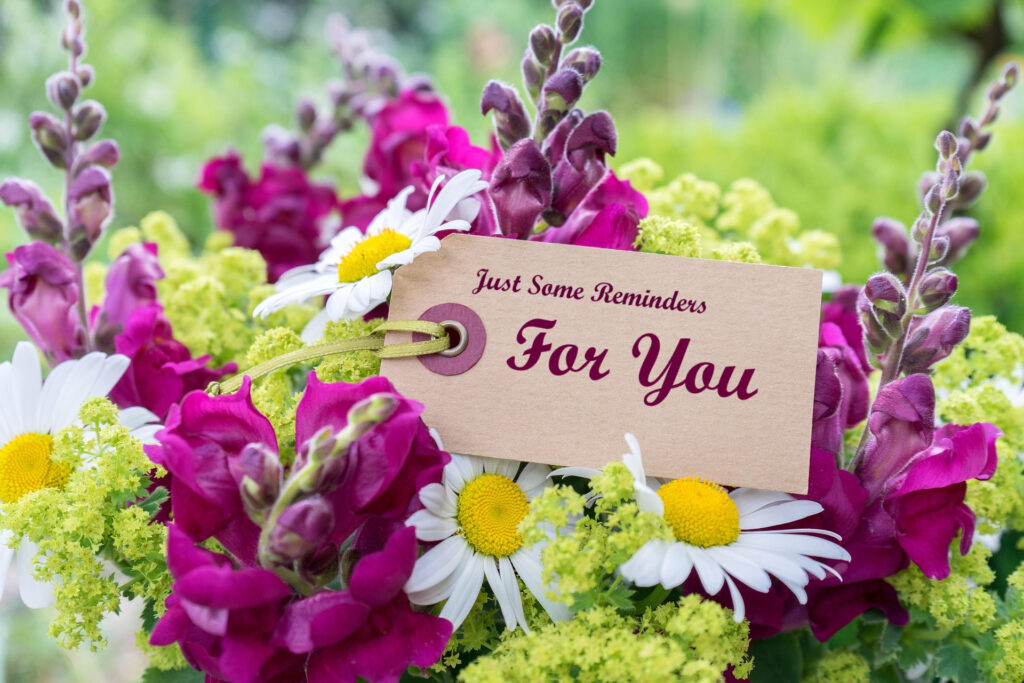
Ruth was worried. I don’t remember what it was exactly, some bout of illness. It was pulling her into a pit of fear. Then one day, the mail brought a card from a friend.

“Look what I got!” she said, retrieving the flower-decked card from the table to show me. “Look what it says!”

She held it up and read it to me with a great big, excited grin. “You are stronger than anything life brings your way.”

“That’s just what I needed to hear!” she said.

Somebody cared. Somebody sent her a reminder. And it made all the difference in her world.

You can find a lot of messages in that little story. Pick the ones that speak most directly to you.

For me, it was the message that we all need encouragement. We all want to know that someone cares about us, believes in us, and sees our strengths.

We’re living in uncertain times, in a world smeared with conflict and confusion. Threats to our safety and well-being assail us from every direction. The demands of everyday living eat up our energy, leaving us drained and weary at the end of the day. It’s hard to be at peace.

But here are some reminders for you, some things I know about you, even if we’ve never met. I send them to you as if I were sending you a fine greeting card . . .

You are stronger than anything life can throw at you.
You are free to chose who you will be, and how you will respond to things.
You have skills and talents you can use and grow.
You can think.
You can create.
You have a great laugh.
You strive to be more patient with others and with yourself.
You follow the good examples of people you admire.
You have a generous and compassionate heart.
You spend time with those you love.
You do your best to do your best, even on the bad days.
You notice nature’s beauty.
You find rewards in extending kindness to others.
You spread cheer with your smile.
You give of your time.
You share your abundance.
You appreciate life’s gifts.
You aim to find the good in every situation.
You see the goodness in others, and in yourself.
You increasingly accept responsibility for your life, for your emotions, thoughts and actions.
You enjoy learning about things that interest you.
You dream of a better world for all.
And you are, whether you know it or not, deeply and truly loved.

Wishing you peace and renewal, and a beautiful day.

Warmly,
Susan
Image by scym from Pixabay

Can We Talk?

I heard a song about this past week’s assassination of Charlie Kirk titled, “The Shot Heard Round the World.”

I believe it was just that.

Let me start by saying I didn’t see or hear Charlie often. But I gauged him to be a decent fellow. Wholesome looking, family man, bright and articulate with a relaxed and friendly confidence that gave him charisma.

If you never heard of him, he’s a guy who went around to university campuses all over the country to talk with students about anything they wanted to talk about.

He drew huge gatherings. News of him spread, primarily among young adults, all around the world.

His views have been labeled many things, depending on who’s doing the labeling.

He talked openly about his Christian faith, his love for his family and for his country. He valued the vision of the nation’s forefathers as expressed in the Constitution. He could tell you why if you asked, and he could explain what he thought comfortably, plainly, with a touch of humor here and there.

He didn’t argue. He just listened carefully to you, so he could understand how things looked from your point of view.

He’d respectfully ask you questions about your thoughts and show you where they differed from how he saw things and why. That was his mode of operation. An open conversation so you could each understand the other, for real, not from some preconceived assumptions.

Of course, with the world being as it – so many cats with their claws out and all this scrappin’ going on – some folks didn’t like Charlie’s point of view at all. It totally disagreed with their own views. To them, his views were toxic and divisive. They decided it was “a threat to our democracy” to let him continue to influence all these young minds. He had to be silenced.

But he wouldn’t be silenced. Regardless of what threats and pressures were brought to bear, he kept speaking. He was growing more and more widely known. Word of his thoughts, of his courage and perseverance were spreading everywhere.

Then he was shot. With a bullet built to kill a grizzly, right there in front of his wife, his three-year-old daughter, his 16-month-old son. Right there in front of the whole world

It was this generation’s JFK moment. A man who inspired them had been fatally shot. This man who gave them a sense of clarity in the midst of a world of danger and confusion, who brought them ideals to strive for in what had seemed to them a meaningless world, this man was dead.

On Friday, his wife, whose courage matches Charlie’s own, made a statement saying to those who tried to silence him, “You have no idea what you’ve unleashed.”

Judging from comments pouring in from across the globe, I think she’s right. People will no longer remain silent about what they believe to be wrong, about what they believe to be right.

Charlie’s voice will not be silenced, his example will not be dimmed. He will speak through all who will openly express their own understanding about what they see as beautiful, good, and true. Even if their views are controversial or differ from their neighbor’s. Maybe especially then. We owe it to ourselves, and to each other, to claim our unalienable right to do so freely.

Personally, I plan to follow Charlie’s lead. I, too, believe that the only way to peace between us all is through free and respectful conversation.

Free speech is the hill on which I will forever stand. If we cannot speak freely, we are not free.

So yes, I’ll join in the swelling chorus: I am Charlie Kirk now. I am Charlie Kirk.

Warmly,
Susan

Image by Gerd Altmann from Pixabay

One Small Step

I was sorting a stack of books this week when I ran across a little gem that i had forgotten— One Small Step Can Change Your Life: The Kaizen Way. It was all the rage in management circles when it came out in 2004. Now it seems to have slipped from view.

That’s too bad. It packs a lot of wisdom.

In fact, I wholeheartedly agree with this review from the book’s back cover by psychologist Dr. Susan Jeffers: “This is a wonderful, very readable book that describes a peaceful and simple way of handling all the difficulties in our lives. You will breathe a sigh of relief as you read it.”

That’s a pretty big claim, but I believe its absolutely true. In short, Kaizen is a technique for change that originated in Japan that promotes the art of taking small steps,

It demolishes the obstacle I call “Looking at the Mountain” that leads to nothing but overwhelm and procrastination.

The “mountain” can be anything at all that you would like to achieve, from doing the after-dinner dishes, to starting an exercise program, or changing careers, or getting started at . . .well, anything.

 You look at the task and it just feels beyond your ability to deal with right now. It’s too complicated, or you don’t have the energy or motivation. So you put it aside and feel a little disappointed with yourself. Bummer.

But don’t despair! It’s Kaizen to the rescue! Instead of looking at the whole mountain, Kaizen gently coaxes you to break it down into teeny-tiny pieces and then tackle just the first little piece.

A few years ago I heard a story about this retired guy who spent his time sitting in front of the TV all day smoking and drinking whiskey. True story.

He lived with one of his kids and didn’t have to make his own meals or do his own laundry or anything.

He spent his days like this for about a year, and one day, from the window by his chair he saw the mailman put the day’s mail in the box at the end of the sidewalk. On a whim, he decided to walk out and get the mail.

It felt kind of good to do that and he started to get the mail every day. After a while, he thought he’d see what it felt like to walk to end of the block, and he did that.

Then he started walking around the block. One thing led to another, and he got so hooked on being in motion and exploring the neighborhood that he gave up his smokes and whiskey and started to jog.

Then he tried running and he liked that, too. And two years after he got out his chair to get the mail, he won a seniors’ marathon racing up Pike’s Peak.

That’s what little steps will do for you.

 Once upon a time, that old fellow would have laughed in your face if you told him he’d be running up Pike’s Peak in a couple years. He probably thought he’d be six feet under by then. But he took that one small first step, and it changed his life.

So the next time a task feels like climbing a mountain, ask yourself what tiny first step can you take.

Maybe it’s just getting up from your chair when the next commercial comes on, and then walking to the kitchen when the next one rolls around. Kaizen. It kind of makes a perfect complement to the question “How easy can I let this be?” Don’t you think?

Wishing you sweet little baby steps on your climb.

Warmly,
Susan

Image by Pexels from Pixabay

When My Neighbor Died

“He was one of those people that it was a privilege to know,” Bob’s cousin said.

The cousin was an old guy, six hundred miles away, with an ailing wife. He wouldn’t be able, he said, to come to the funeral. He knew that Bob and I had been longtime neighbors and friends and wanted to make sure I knew that Bob had passed.

His comment about Bob was the most healing thing anybody ever said to me when someone dear to me died. Instead of deepening my feelings of loss, his words elevated Bob to the pedestal he deserved in my mind.

Instead of a focus on the emptiness his passing left in my life, they let me feel enriched by having known him. They freed me to recall all that we had shared together, the good times and bad, and to find peace in remembering.

They shifted my focus from me, from my sadness over the big hole Bob’s passing left in my world, and instead, let me feel like I’d been honored just to know him.

That was a new feeling for me when it came to Bob. Often, I viewed him as a pest intruding on my valuable time. He could ramble on for half an hour without saying a single thing that I could relate to. But he had a good heart and a sweet disposition and I couldn’t deny him my ear.

A couple months have gone by since he died, and I still hear his cousin’s words when something reminds me of Bob. They wrap the memories in a kind of warm glow that unfailingly makes me smile.

Now I realize how true his cousin’s words are, not only of Bob, but of everyone. Even the ones we don’t especially enjoy or think well of.

Everyone is a teacher. Everyone plays his part. Everyone, even the annoying or upsetting ones, does the best he can to get through life in whatever way he knows.

In the long run, we learn things from everybody who touches our lives. Each one enriches us, expanding our knowledge and understanding of life, and of ourselves.

We learn humor from the people in our lives, and compassion. We hear tales of adventure, of courage and cowardice. We hear how kind people can be, and how treacherous, how brilliant and how stupid.

The people in our lives show us what we judge as good and bad. We learn what pleases us and what doesn’t. And if we’re lucky, we learn to see how others mirror parts of ourselves, deepening our insight into who we are. They help us see what we can aspire to, and what we want to decline.

It may not feel like much of a gift at the time. You might wish you’d never met someone. You might wish he’d just disappear. You might feel a bitter taste in your mouth whenever you think about this one or that.

But everyone who enters your life is only there to let you see your own self more clearly, and for that they deserve your recognition, regardless of any other judgments they may stir.

Recognizing them as a teacher opens you to recognizing the privilege they offer you simply by appearing in your life, the gift their presence brings.

For me, the gift Bob brought was a lesson in turning grudging tolerance into genuine appreciation. Granted, it took me a long time to open that gift and a lot of inner effort to adjust my attitude. But he kept coming back until I finally got it, until I realized that knowing him was, as his cousin said, a privilege.

It’s a privilege for me that you’re here, too, reading these words, letting me share my thoughts with you. May they help you open the gifts that others bring you with a fresh awareness of the richness and wisdom they hold.

Wishing you a week of golden rememberings.

Warmly,
Susan

Who’s Piloting this Craft?

There’s a little pub I pass in my travels that has a chalk-board sign on the curb outside its door.  On it, the proprietor writes jokes or pokes that make you smile.  It gives the pub a friendly feel and gives passersby a grin. 

Today the chalk board said—

The Bad News: Time Flies.
The Good News: You’re the Pilot.

That was a poke right to my ol’ cerebral cortex, I’ll tell you.  It got me musing about how we experience time in our lives and about whether we really are the pilots.   

I had a pretty big discussion with myself about that last part, and I decided it’s up to each of us to decide whether we’ll accept the role of pilot or leave it to others. 

Think of your life as the craft that you sail to cross this span of time. As the pilot, you can choose to define how you will use your time. You can say that you’re dedicating it, or devoting it, or committing it. 

You can say that you killed it, spent it, squandered, lavished, or invested it. You can label it good or bad. You get to frame it any way you choose. “Choose wisely, grasshopper,” as the Shaolin monk, Master Po, often said,

You can’t stop time’s current, but when you let yourself go with its flow, you can learn to let yourself float on it, like a feather on a stream.

And sometimes you can rise above it entirely, to a dimension where, yes, time exists, but only down there–in the physical world, where it’s part of the planet’s operating system. 

It was designed that way on purpose, this experience of time. It came with the package; it’s part of the learning and fun. It gives us rest and it wakes us. It’s what makes life an adventure. 

Time lets you experience things you’d never feel without it: pressure, anxiety, anticipation, suspense—countless feelings. It lets you plan and make appointments. It obeys a steady measure to help you coordinate with others, to track the miles, to remember the days.

The list of time’s advantages just goes on and on. Without time, there would be no tomorrows or yesterdays, no seasons, no waxing and waning moon.

And you are the pilot riding time’s stream. You get to make the decisions about how you want to navigate, how you want to respond to time’s stretches of turbulence and calm.  

Sometimes it’s easy going and you can cruise on auto-pilot.  But sometimes you want to take control, to make your own decisions.  And sometimes, it’s best to call to the Tower for guidance and advice.

The important thing (especially if your auto-pilot is stuck) is frequently to remind yourself that you are the pilot of this craft. It’s your life.  

May you have a week of excellent choices!

Warmly,
Susan

Image by G.C. from Pixabay

Opening to the Possibility

Scribbled in an old notebook I was paging through, I found this piece of advice: “Maintain an openness to the possibility that things may work out just fine.”

Now I’m a fairly optimistic person. I tend to look for and find the good in almost every situation I encounter. But I must confess that I have a dark streak, too, that emerges when I contemplate the direction in which the world seems to be headed.

It’s hard to find much light out there. Civilization seems to be careening towards increasing anarchy, hostility and chaos. The globe itself, from all reports, is bathed in toxins and under assault from forces beyond our understanding or control.

Our knowledge may be increasing at an exponential rate, but our understanding and wisdom seem far from keeping pace.

So when I read that little suggestion to keep myself open to the possibility that things may work out just fine, it stopped me in my tracks. That light-filled possibility had slipped entirely from my view.

That little possibility packs a lot of positive motivation inside it. Call it faith. Call it hope. It can keep you going when the deck looks stacked, when the odds, and reason itself, seem to tell you there’s no way. It reminds you that wildly unreasonable things do happen—absolutely every single day.

Even for the ordinary challenges, it’s a good suggestion to carry in your back pocket. It’s one of those items, like spare keys or safety pins, that it’s handy always to have on hand.

Your boss comes down on you, you get stuck in traffic when you’re headed for a critical appointment, you forget your partner’s birthday, you leave the notes for your presentation behind.

When roadblocks appear, pull out that little reminder; slip it into your considerations: Be open to the possibility that things may work out just fine.

The possibility is there, whether you can see it or not. Keeping a window open for it gives you a shot at spotting it. It lets you keep an eye out for ideas.

When you’re grappling with personal challenges that seem insurmountable, remember that things could work out just fine. Instead of focusing on the problem, let yourself imagine what the solution might look like. Don’t worry how it could come about. Instead, focus on a vivid, detailed picture in your mind of a fine outcome being real.

That’s what the possibility of a good outcome does on a global scale, too. It keeps us looking for ideas, for that glimmer of light that shows the way around, or over, or through.

And isn’t it interesting, how we tend to find what we’re seeking only if we believe that an answer can be found.

Wishing you a week of openness to fine possibilities.

Warmly,
Susan

Image by Pexels from Pixabay

Expanding the Perfect Moment

Once I read a novel that revolved around a 17-year-old boy. In the story, he’s a rather anxious young man, having suffered a traumatic mugging and then discovering his father in the arms of a woman who wasn’t his mother.

His parents are divorcing, and he’s been sent to live in a mountain wilderness where he’s cautioned not to leave the house without bear spray to defend himself against grizzlies.

In one minor passage of the book, he wakes to find himself inside “the perfect moment.” It’s a fleeting instant of time where no shadows from the past lurk and no fears of the future intrude.

He loves that moment and wants to extend it, but he’s thrust into his immediate circumstances before he can succeed.

When I read that passage, I immediately identified with the feeling of his “perfect moment.” You’ve probably had a few of them yourself. Maybe many. Maybe often. Maybe even now.

Capturing the perfect moment is hardly the young man’s main concern in the story. But I thought I’d share a way that you can expand your own “perfect moments” when you notice that you’re experiencing one.

Noticing one is the first step. And the way to do that is to remind yourself that you’re going to watch for them. You can set an intention at the beginning of your day, for example, or put a loose rubber band on your wrist to remind you to catch them when they occur. Invent your own reminder. You know what works for you.

The second step is developing a sense of how the perfect moment feels. It’s holds feelings of deep contentment, of total acceptance of everything the moment holds exactly the way it is.

It’s empty of concern for anything in the past or future. It’s a moment of wakefulness, where your senses feel alive and where sensing is pleasant and vivid. It’s being fully present in this very instant of now.

As the young man in the novel noticed, perfect moments can be fleeting. Distractions enter the scene.

And a distraction can make it disappear. But it doesn’t have to. (Unless, of course, you’re facing a grizzly bear.) Instead of letting the distraction pull you out of your perfect moment, welcome it into the moment and let it be a part of the perfection, too.

Because the perfect moment is generated by the heart, not by the head.

In fact, the more that you cultivate feelings of welcoming acceptance, appreciation and wonder, the more often perfect moments are likely to occur. And the more fully you feel these warm feelings from your heart, the more willing your brain will be to relax and allow you to bathe in them.

The fact is, your brain likes this state as much as your heart does. It’s called “coherence,” and it allows you to function at an optimal level.

If you have challenging mental work to do, being in coherence allows you to do it in the “flow” state, where concentration comes with ease and time seems to disappear.

If you’re doing a casual activity, coherence will allow you to do it with a sense of heightened pleasure in all that your senses are bringing you.

There are volumes of studies about all sorts of health benefits, too. But the main benefit, in my view, is the expanded joy that living inside perfect moments brings to life.

I wish you heightened awareness of them and happy practice in expanding them to fill more and more of the moments in your life.

Warmly,
Susan

Image by mooremeditation from Pixabay

Stars

I used to think God put the stars away
on rainy nights to keep them from rusting.
You wouldn’t want rusted stars after all.
Then I thought maybe stars are
just twinkles in God’s eyes.
Now I imagine the whole universe
may be only a dot on a map
in God’s ever-expanding mind.

Image by sebastian del val from Pixabay

Have You Noticed Lately?

Sometimes you stumble across things that remind you of one of the central things you always find worth remembering. Today, for instance, I happened across this poem. . .

Instructions for the Journey*
By Pat Schneider

The self you leave behind
is only a skin you have outgrown.
Don’t grieve for it.
Look to the wet, raw, unfinished
self, the one you are becoming.
The world, too, sheds its skin:
politicians, cataclysms, ordinary days.
It’s easy to lose this tenderly
unfolding moment. Look for it
as if it were the first clear tone
in a place where dawn is heralded by bells.

And if all that fails,
wash your own dishes,
Rinse them.
Stand in your kitchen at your sink.
Let cold water run between your fingers.
Feel it.

It’s that easy, really. A mere shift of attention. A choice to notice that you’re alive, in the very center of this tenderly unfolding moment, bathed in its light and color and motion and sound.

You notice your body—what it’s doing, how it’s positioned, how it feels, what emotions are flowing through it.

For a moment, you might even be startled by the wonder of it, by the reality of breathing, of air itself, and by the fact that you have skin and hands and eyes, all doing miraculous things for you without your even paying them attention,

They don’t last long, these snatches of awareness. We get pulled back into the tasks at hand, into our planning, our figuring out, our memories and goals and dreams. But we had that moment, and it refreshes us somehow.

And all that it takes to have more is a little reminder, some tug, to notice, to pay attention. Because it’s always right here. Whatever you’re doing, whatever you’re feeling, you’re always right here, too, in this moment in time, in this kaleidoscopic, every-changing world.

When you find yourself in one of these moments where your attention shifts to the wonder of it all, to the wonder of the fact that, despite all odds, you’re alive in the very midst of it, thank yourself for noticing. That will teach your brain how nice it is to remind you, from time to time, to notice.

And, as the poet said, if all else fails, wash your own dishes. Watch how your hands know how to move. See the soapsuds. Feel the water.

Say thank you.

Wishing you a week of noticing.

Warmly,
Susan

*From The Poetry of Presence, An Anthology of Mindfulness Poems,
© 2017 Phyllis Cole-Dai & Ruby Wilson, editors [God bless them.]
www.graysonbooks.com
www.poetryofpresencebook.com

Treat yourself to a copy. It’s filled with the kind of words you need to hear just when you need to hear them.

Image by eommina from Pixabay

The Wishing Star

Remember how, when you were a kid, you learned to make wishes on a star? You’d stand there in the dark, close your eyes, tilt your head toward the sky, and when you opened your eyes again, focus on the first star you noticed and say the magical chant. . .

“Star light, star bright
I wish I may, I wish I might
Have the wish I wish tonight.”

Then, silently, you’d tell the star your wish.

It was sort of like making a wish when you blew out the candles on your birthday cake. Except that wish came only once a year. Wishing on a star was something you could do on any clear night.

Remember how it felt, sorting through the crowd of wishes you could make to find the exact right one, to name the one wish, above all, that you most wanted to come true?

And as soon as you told it to the star, remember how easily and simply you let it go and went on with the night, happier somehow that you made it?

What a wonderful game! Not only did it give you a chance to look up to the star-glittered sky, to sense the vastness and wonder of it, but it let you tune in to your innermost heart, too. It let you listen to its desires. It let you taste each one, to weigh the depth of your desire for it, and then, in a moment of clarity, to pick the best one, imagining how delicious it would feel to have that one come true.

You can still do that, you know. Even if you’re somewhere that you can’t see the sky, the sky is still there and still sparkled with a billion stars, just waiting for your wishes.

If you were going to make a wish right now, what would you wish for? What’s the one thing your heart would most like to have come true?

That’s a good thing to know. It gives you clarity about what, at this moment, you want to experience more than anything. And when you have clarity about that, amazing things can happen.

I wrote a poem once with lines that said, “When you wish upon a star, your dreams come true, although not necessarily in the time, or form, or manner that you’d imagined.”

One day, maybe a week down the road, maybe a year or a decade or two later, you realize you followed a nudge, moved in the direction of a new idea, made unexpected connections, spotted new opportunities. And now here you are, experiencing the very reality you wished for.

Not because a star in the sky made it happen, but because you did, because your wishing let you know what you truly wanted and set that wish as a guiding star within you.

“Star light, star bright, I wish I may, I wish I might. . .” Whisper that to a star some night. Then let it go, taking the magic of the moment with you. You’ll be glad you did.

I’ll be wishing wonderful wishes for you.

Warmly,
Susan

Image by Gerd Altmann from Pixabay